


Personal finance loves a clean formula.
Earn money. Spend less than you earn. Pay off expensive debt. Save three to six months of expenses. Automatically invest part of every paycheck. Keep doing that for a few decades and let compounding take care of the rest.
There is a lot of good advice in there.
I save. I invest. I think having cash available for emergencies is incredibly important. I don’t have some new theory in which compound interest has suddenly stopped working.
But there is one line missing from the top of the spreadsheet:
Keep the income coming in.

I started thinking about this after seeing two financial posts within a few hours of each other.
One said that a person earning $100,000 and spending $95,000 could remain broke, while someone earning $70,000 and spending $45,000 could build wealth.
Another described financial freedom as paid-off credit cards, six months of expenses in the bank, automatic investing and enough savings to leave a job you hate.
I understand both arguments.
My immediate reaction was still: And then what happens?
Because all of this works beautifully while the income continues arriving.
Life has a fairly irritating habit of getting involved.
We’ve been giving people versions of the same advice for a very long time
This isn’t some new TikTok trend.
A Richest Man in Babylon was telling people a century ago to keep a portion of what they earned and put it to work. The famous principle was essentially: save part of your earnings, then make those savings earn more money.
Fast-forward to today and the language changes more than the underlying mechanics.
Dave Ramsey’s Baby Steps tell people to eliminate debt, build an emergency fund covering three to six months of expenses and then invest 15% of household income for retirement. Ramsey Solutions explicitly calls income your “best wealth-building tool.”
Ramit Sethi’s Conscious Spending Plan is considerably less obsessed with deprivation, but it still begins with take-home pay. The plan allocates that money among fixed costs, investments, savings and guilt-free spending.
Tori Dunlap’s Her First $100k teaches women to build an emergency fund, manage debt and invest. She has talked openly about automatically transferring a percentage of each paycheck into savings while building her first $100,000.
These aren’t identical philosophies. Some of these people also talk about earning more, negotiating, entrepreneurship and other ways to increase income.
And I’m not arguing that their basic financial advice is bad.
I’m arguing that most of our personal-finance machinery still starts at roughly the same place:
Money comes in first. Then we decide what to do with it.
That’s completely logical.
It also means there is a part of wealth building we don’t discuss nearly enough: what happens during the years when less money comes in—or none does.
If this is the kind of conversation you’ve been looking for, subscribe to FU Money Plan.
I write about building income, assets and options you own—so your financial future doesn’t depend on one job, client or platform.
The gap isn’t wealth
Let’s go back to that $100,000 example.
If I earn $100,000 and spend $70,000, I’ve created $30,000 of surplus capital.
That is useful. Very useful.
But the $30,000 gap itself isn’t wealth creation.
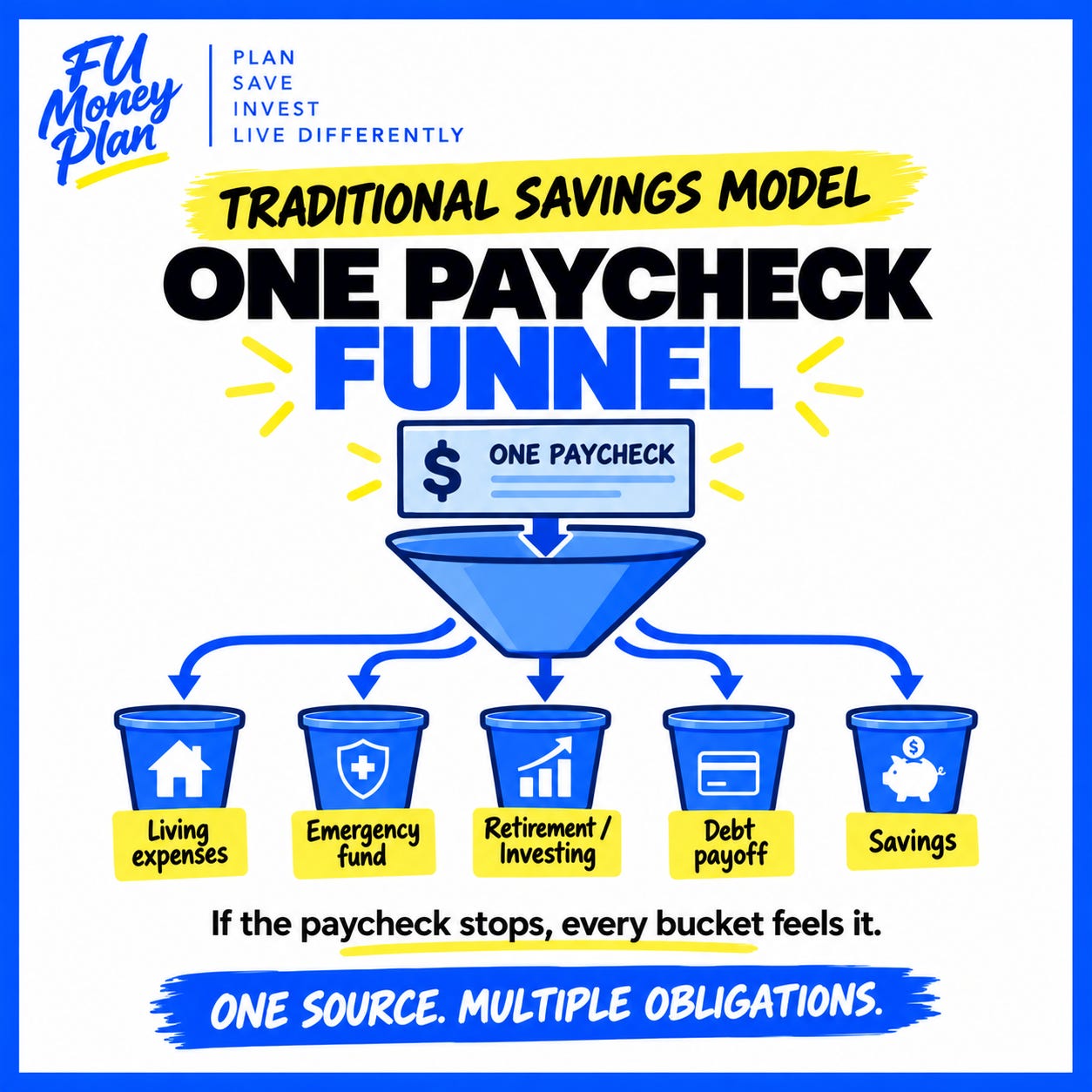
If I leave it sitting in cash indefinitely, I’ve accumulated savings. If I use some of it to buy or build assets that can appreciate or produce income, now I’ve begun using that surplus to build wealth.
Traditional investing advice understands this perfectly well. “Invest the rest” is basically the point.
The vulnerability appears on the way there.
You need enough income above your current expenses to generate surplus capital. Then you need enough uninterrupted time for those contributions and their returns to become substantial.
And a lot can happen between age 25 and age 65.
Money is boring. Life isn’t.
Imagine you’ve done everything properly.
You paid off the credit card.
You have six months of expenses in savings.
Your investment contributions happen automatically.
Then you’re fired or laid off.

In August 2026, the median duration of unemployment in the United States was 11.4 weeks. But almost 1.93 million unemployed people had already been out of work for at least 27 weeks—roughly six months or longer. That represented 27% of unemployed people.
Six months is not some bizarre disaster scenario.
And if your emergency fund contains six months of expenses and your job search lasts seven, eight or nine months, something fairly predictable starts happening.
First your investment contributions stop.
Then your savings stop growing.
Eventually you begin spending the savings.
Maybe the credit card comes back out.
The wealth-building machine hasn’t merely slowed down. Depending on how long the interruption lasts, it can start running backward.
And layoffs are only one way this happens.
You have a baby and decide to stay home for a while.
You have a baby and discover that childcare costs make staying home the only sensible option.
You get sick.
Your spouse gets sick.
One of your children needs additional care.
Your father has a stroke.
Your mother develops dementia.
You decide at 35 that you hate the career you chose at 21 and go back to school.
You burn out.
You move countries.
You start over after a divorce.
You leave employment to try self-employment and discover that revenue takes considerably longer to arrive than the people on Instagram suggested.
None of these situations is particularly exotic.
Apparently the spreadsheet has never met a toddler, a corporate restructuring or an American insurance company.
Women run into this problem earlier and more often
This is where the clean version of wealth-building starts bothering me.
Because interruptions are not distributed equally.
In 2025, 68% of mothers with children under six participated in the U.S. labor force. Among fathers with children under six, the rate was 95.3%.
For a lot of mothers, the math stops working
Women are already starting from behind financially.
Among full-time, year-round U.S. workers, women’s median earnings were 80.9% of men’s in 2024, down from 82.7% in 2023. That was the second consecutive year the female-to-male earnings ratio declined after decades of gradual improvement.
Then you have a child.
Now add childcare. The national average price of childcare reached $13,184 per child in 2025. For two children in center-based care, the cost was higher than median rent in every one of the 47 states with available data, and higher than typical mortgage payments in 39 of them.
And childcare is only part of the equation. Going back to an office can mean commuting, gas, parking, work clothes, lunches, backup care when a child is sick, after-school care, summer care and all the logistical gymnastics required to make a traditional workday fit around a school day that ends several hours earlier.
Then there is flexibility. Research consistently finds that it matters enormously to mothers with young children. In one large workplace study, 38% of mothers with young children said they would have had to leave their company or reduce their hours without workplace flexibility. BLS research has also found a strong relationship between remote or hybrid work arrangements and mothers remaining employed.
So imagine a two-income household where the woman earns less, which is still statistically common. She returns to work, but a substantial portion of that second paycheck now goes toward childcare and the costs of enabling her to work in the first place.
With two young children, the calculation can become brutal.
From a short-term household-budget perspective, somebody looks at the spreadsheet and says: Why are we doing this?
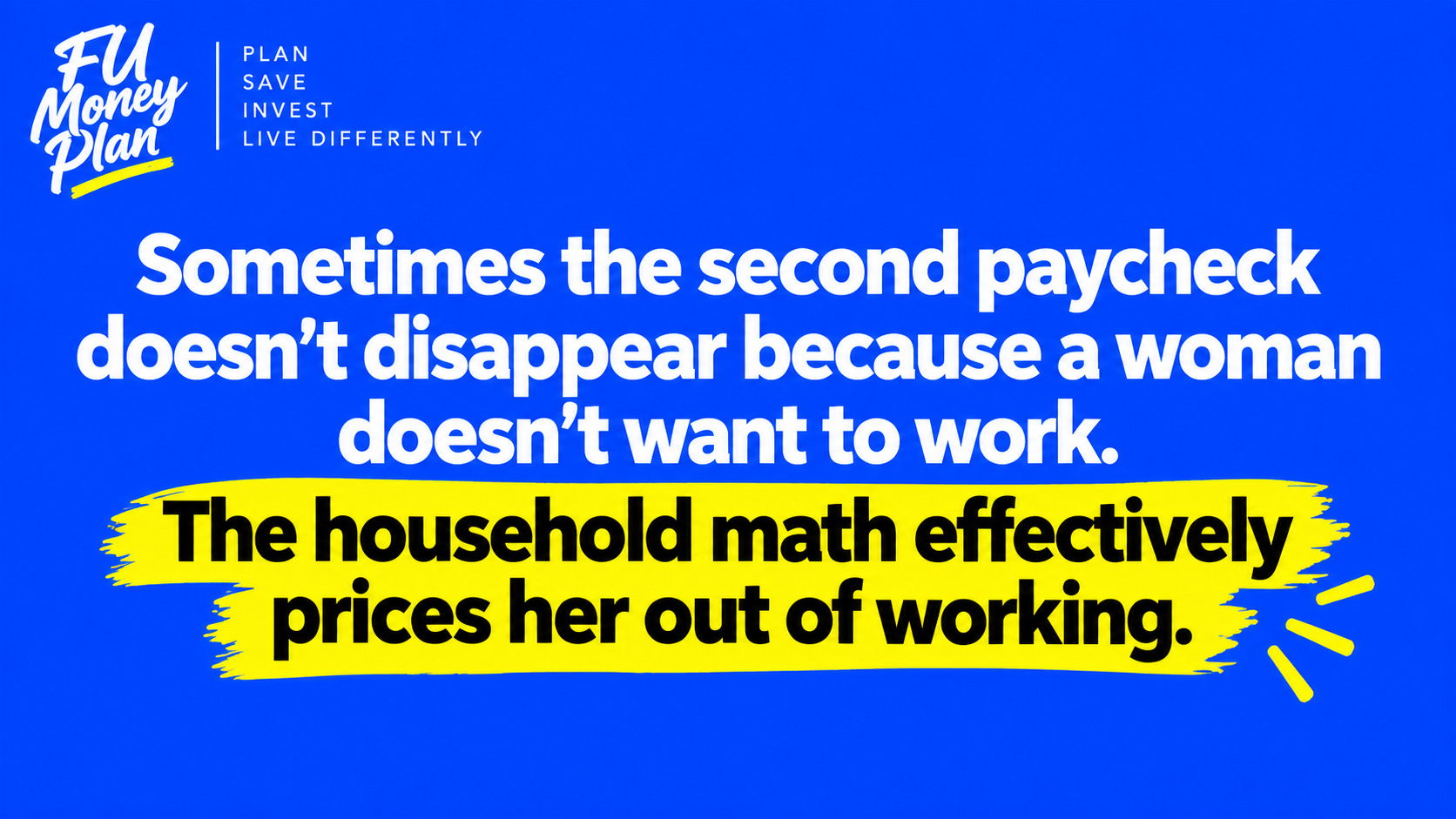
And because the woman is more often the lower earner, she is more likely to be the person whose job gets treated as optional.
There is a cruel financial irony here. Leaving work may make perfect sense for the household today, while making the woman—and the household—more financially vulnerable over time.
She loses current income, retirement contributions, raises, promotions and years of compounding. Re-entering later can be difficult. Research on the motherhood penalty finds that women’s earnings and employment can fall substantially after childbirth, while fathers’ earnings trajectories do not show the same pattern.
And now the family has gone from two paychecks to one.
Four people may suddenly be depending on one employer continuing to employ one person.
Which takes us straight back to the problem at the center of this article: we’ve built a wealth model that becomes more fragile precisely when life becomes more complicated.
That last part is the payoff. It connects this section directly back to your thesis instead of turning it into a separate essay about gender inequality.

Whatever somebody’s individual reasons for leaving or reducing work—and they vary enormously—that gap has financial consequences.
Every year outside the workforce can mean less current income, fewer retirement contributions, less employer matching, fewer raises and fewer years for invested money to compound.
Then caregiving enters the picture.
AARP and the National Alliance for Caregiving estimate that 63 million Americans are family caregivers—about one in four adults. Nearly half reported at least one major financial effect from caregiving, such as taking on debt, stopping savings or struggling with basic expenses.
The newer numbers on the sandwich generation are even more interesting. Nearly 17 million Americans are simultaneously raising children and caring for an adult with a serious medical condition or disability. Sixty-seven percent reported some form of work disruption because of caregiving.
These aren’t people who forgot to automate their Roth IRA.
Their lives changed.
Some people also start with much less room between income and expenses
There is another problem with making “the gap” the hero of the wealth story.
Not everyone has the same ability to create one.
Among full-time U.S. wage and salary workers in the second quarter of 2026, women’s median weekly earnings were $1,131 compared with $1,380 for men. Median weekly earnings were $1,029 for Black workers, $997 for Hispanic workers, $1,268 for White workers and $1,713 for Asian workers. Those figures describe medians; they don’t explain the causes behind the differences. But they do show that people enter the save-and-invest equation with very different amounts of income.
Employment risk isn’t distributed evenly either. In August 2026, the unemployment rate was 3.7% for White Americans, 6.0% for Black Americans and 4.8% for Hispanic Americans.
People with disabilities face an even larger divide. In 2025, their unemployment rate was 8.3%, compared with 4.1% for people without disabilities. Employment rates differ sharply too, partly because the disabled population is older, although BLS reports that people with disabilities were less likely to be employed across all age groups.
So when we hand everybody the same formula—
earn, save, invest, repeat—
we shouldn’t be surprised that people have very different experiences following it.
Someone earning less has less surplus to invest.
Someone leaving the workforce for two years loses two years of contributions.
Someone repeatedly moving in and out of employment may have to spend the emergency fund they just finished building.
Someone caring for a parent may be choosing between maximizing a 401(k) and reducing their work hours because Dad cannot get himself into the shower anymore.
“Just keep investing 15%” becomes considerably less useful advice at that point.
The traditional plan covers part of the problem
I still want the emergency fund, the retirement account, and the diversified investments compounding quietly in the background.
Please don’t read this article, cancel your 401(k) and launch a Canva template shop.
What I want is more than one mechanism supporting my financial future.
Because if the entire accumulation phase depends on my ability to sell my labor to one employer for the next few decades, I have a major point of failure. Losing that job doesn’t just interrupt the plan. It can send your entire financial life into a black hole.

The career ladder wasn’t entirely imaginary
We tend to romanticize the old working world as if everyone joined IBM at 22, got a gold watch at 65 and never changed employers. That wasn’t really true. Late baby boomers born between 1957 and 1964 held an average of 12.9 jobs between ages 18 and 58, although nearly half of those jobs were concentrated in their early working years.
What was different was what happened once people got established. Long tenure with one employer was much more common among older workers, particularly men. In 1983, the typical employed man aged 55–64 had been with his current employer for 15.3 years. By 2000 that had fallen to 10.2 years. Among men aged 45–54, median tenure fell from 12.8 years to 9.5 years over the same period. In 2024, median tenure for men aged 45–54 was down to 7.5 years.
The financial system was also built to reward staying put. In 1975, about 39% of private wage and salary workers were covered by a primary defined-benefit pension, the old-fashioned pension where the employer promised a retirement benefit based partly on salary and years of service. Only about 6% were primarily covered by a defined-contribution plan. By 2024, only 15% of private-industry workers had access to a defined-benefit plan, while 70% had access to a defined-contribution plan such as a 401(k).
So the old career ladder wasn’t simply about people being more loyal. The system itself gave them more reasons to stay. Longer tenure could mean promotions, salary progression and a pension whose value increased with years of service. The employer wasn’t just where your paycheck came from. It was often where a large chunk of your long-term financial security lived too.
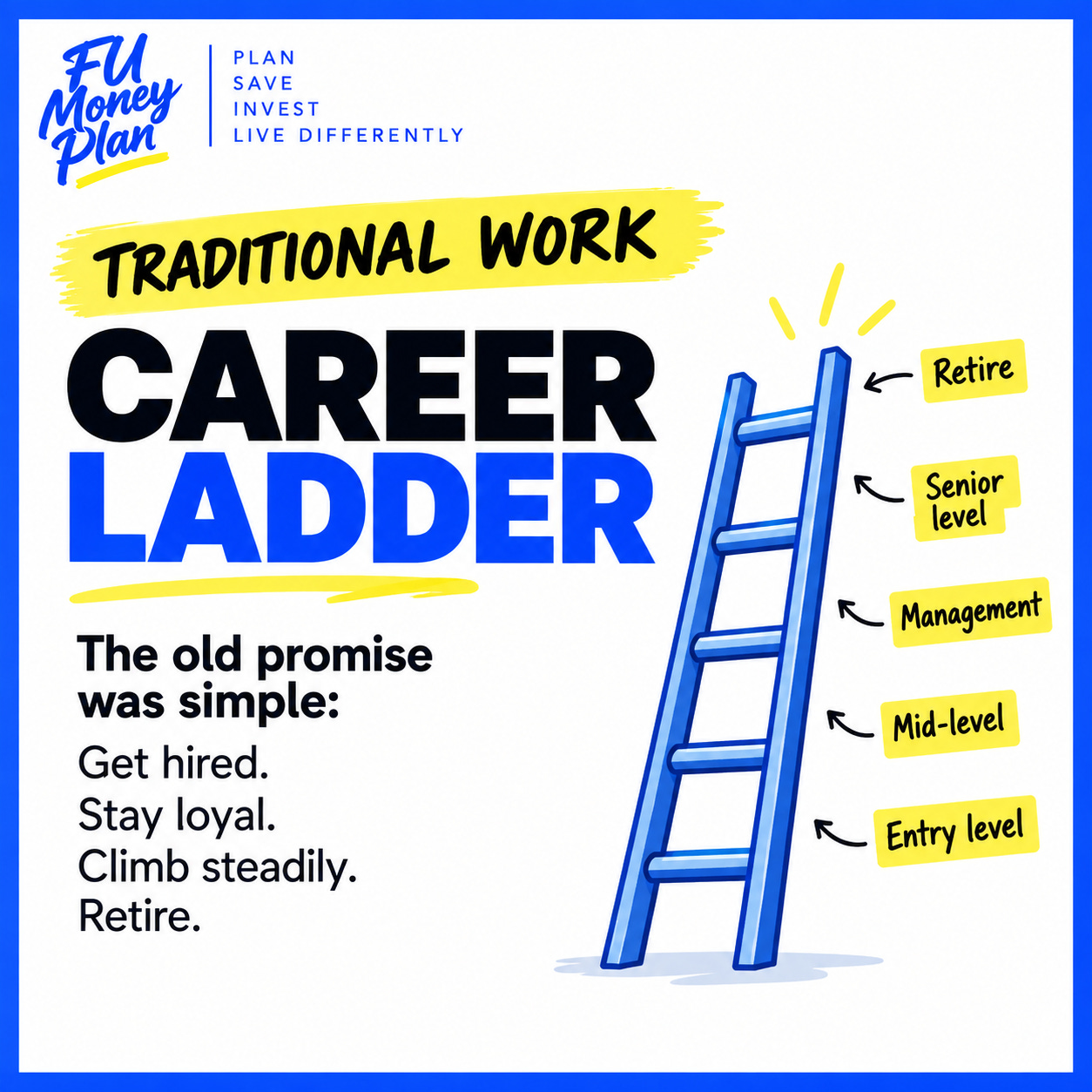
That model has been eroding for decades. The career ladder hasn’t disappeared entirely, but it no longer describes the way a huge number of people actually work.
Maybe you spend five years in a full-time job, freelance for a while, step away to have a child, return in a different industry, consult, take another salaried role, get laid off, and eventually build something of your own.
That’s less of a career ladder and more of a career jungle gym.
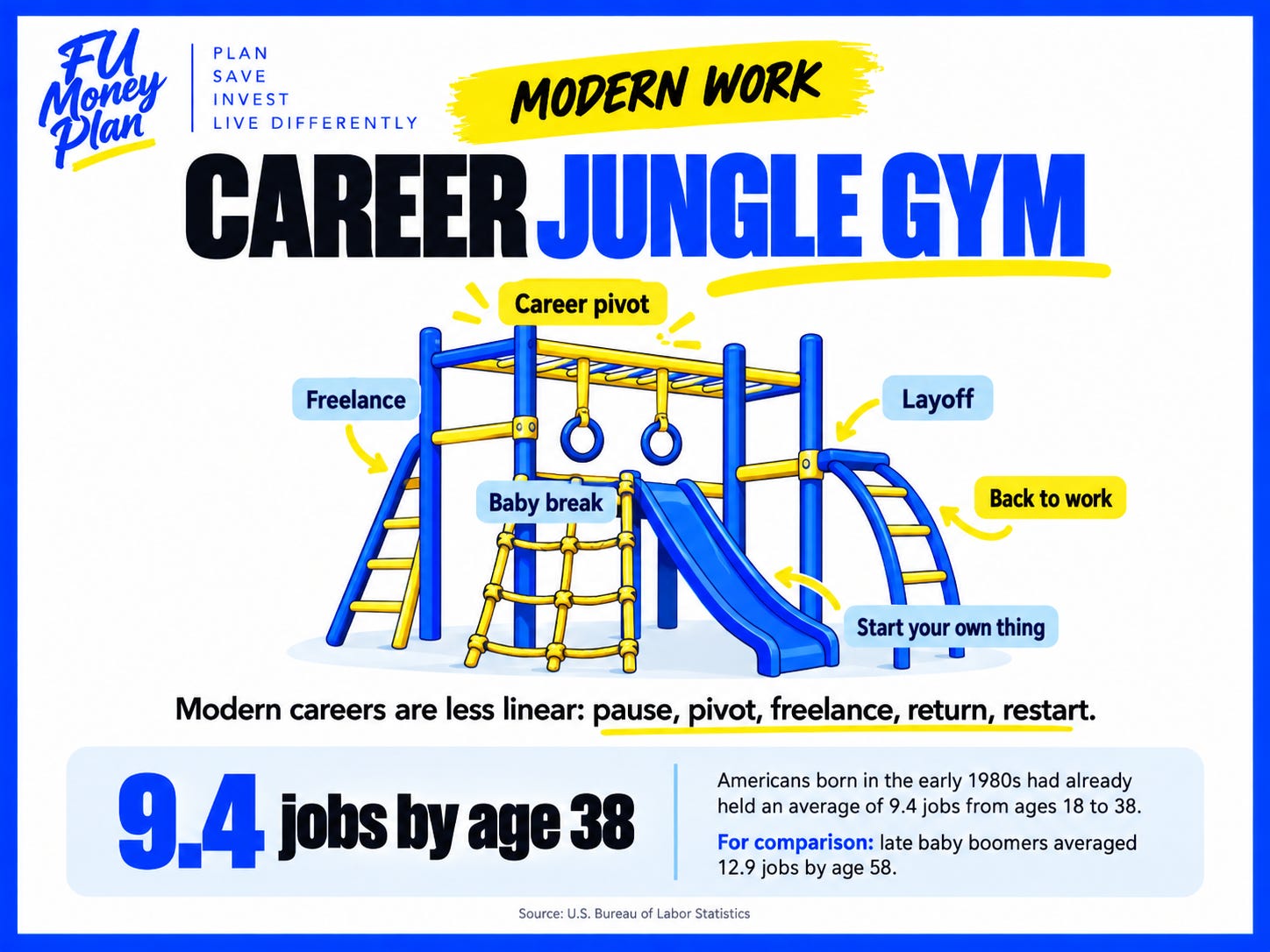
In August 2026, nearly one in five Americans ages 25 to 54 wasn’t employed at all. About 4.1 million were unemployed and looking for work, while another 21.8 million were outside the labor force. That second group includes all kinds of lives that don’t fit neatly into a retirement calculator: parents, caregivers, students, people dealing with illness, people taking career breaks and people who have temporarily stopped looking for work.
Even among people who are working, the standard full-time employee model isn’t universal. The Bureau of Labor Statistics found that roughly 10% of employed Americans had an alternative work arrangement as their main job, including nearly 12 million independent contractors, consultants and freelancers.
And our careers themselves aren’t particularly linear. Americans born in the early 1980s had already held an average of 9.4 jobs by age 38.
So when we build an entire theory of wealth around decades of uninterrupted paychecks, we’re designing for a version of working life that a huge number of people simply don’t have.
Maybe you spend five years in a full-time job, freelance for a while, step away to have a child, return in a different industry, consult, take another salaried role, get laid off, and eventually build something of your own.
That doesn’t look like the tidy career ladder many of us were taught to expect.
It looks a lot more like modern life.
So I think our wealth-building model needs to catch up.
I want to decentralize the paycheck
This is a big part of what FU Money Plan means to me.
I don’t want one paycheck carrying the entire load.
I want cash available when things go wrong. I want investments working in the background. I want my fixed expenses low enough that I have room to move. I want skills that remain valuable if an employer stops valuing them.
And I want at least some income to come from things I own.
That last part is where my own thinking has changed the most.
For decades, many professionals spend their working lives building things for somebody else.
We develop frameworks, solve difficult problems, learn an industry, build relationships, understand customers, create processes, write, teach, present, manage and make decisions.
There is often a surprising amount of economic value inside that knowledge.
Yet plenty of people reach 35, 45 or 55 having never asked:
Could any of this earn money without my employer in the middle?
That doesn’t mean everyone should quit and become an entrepreneur.
You don’t need a personal brand with 200,000 followers.
You don’t need to become a seven-figure course creator.
You may not even know what kind of business you’d want yet.
Your first experiment could be considerably smaller.
Maybe somebody pays you $300 to help solve a problem you already know how to solve.
Maybe that becomes a workshop.
Maybe the workshop turns into a repeatable service.
Maybe the service produces a framework.
Maybe the framework eventually becomes a product, book, licensing model, newsletter, software tool or something else entirely.
The first goal isn’t “build a company.”
It’s proving that your paycheck is not the only place money can come from.
For somebody who has spent their entire career receiving money from one employer, that first $500 earned independently can change the way they see their own options.
This is why I’m interested in intellectual property
I have a particular bias toward intellectual property because it lets people turn knowledge they already have into something they can own.
But IP gets romanticized too.
A course nobody buys is not financial freedom.
A PDF sitting in Dropbox is not an asset.
A newsletter nobody reads doesn’t magically compound because you called it a media company.
And replacing dependence on one employer with dependence on one client or one social-media platform isn’t much of an upgrade.
Useful IP needs demand. It needs distribution. It needs some mechanism for turning value into revenue.
Once those pieces exist, though, something interesting happens.
Your work is no longer limited entirely to time spent working today = money received today.
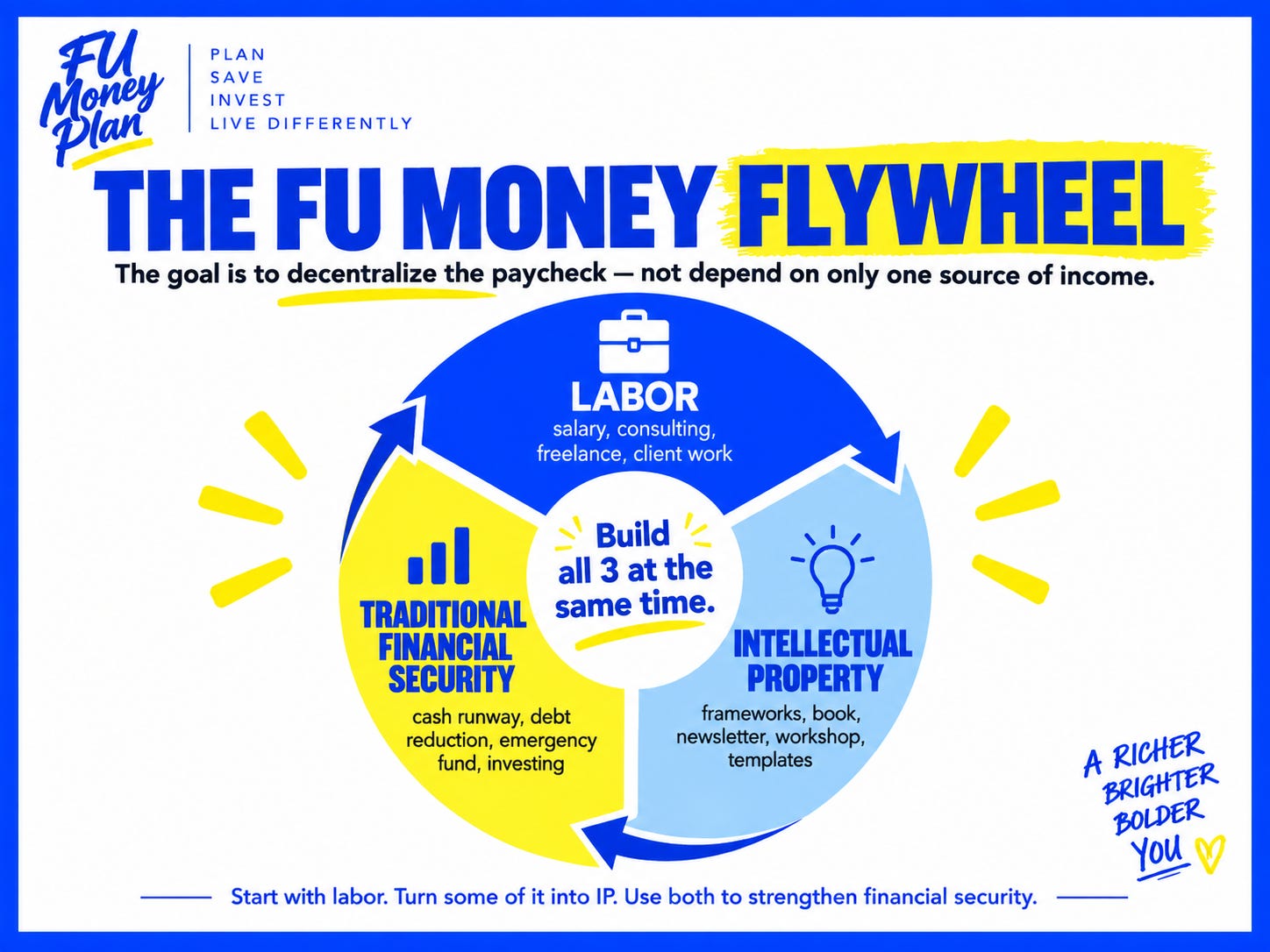
A book can sell more than once. A workshop can be rerun. A framework can be licensed. A product can keep earning without you recreating it every time. Add an audience, a business, and traditional investments, and suddenly your financial life isn’t resting on one source anymore.
My own career cured me of believing the straight line
I didn’t arrive at this because my career went according to plan.
There was a point in my life when I had the kind of résumé I thought should have made employment relatively straightforward.
Then I spent roughly two years trying to get hired.
That was extreme. I’m not suggesting everyone who loses a job will be unemployed for two years.
But it taught me something I haven’t been able to unsee since.
A successful past doesn’t guarantee access to your next paycheck.
Neither does working hard.
Neither does being smart.
Neither does having a good title.
There are parts of our financial lives we control and parts we absolutely do not.
I became much more interested in building the things I could control: the skills and knowledge I carried with me, the relationships and reputation I had built, the audience I could reach, the IP and products I owned, and the investments I was making.
Because if one source of income disappeared, I wanted to know I could create another.
That’s where FU Money Plan came from.
We need a wealth model for people with unpredictable lives
I don’t want to throw out traditional personal-finance advice.
Keep the good stuff.
Pay off expensive debt.
Have cash available.
Invest.
Take the employer match.
Don’t increase your lifestyle every single time your salary goes up.
All sensible.
I simply don’t think that’s enough anymore.
We also need financial planning for the person who takes two years out with a baby.
For the 32-year-old who has been laid off twice in four years.
For the freelancer whose income arrives in strange lumps.
For the person caring for an aging parent.
For somebody managing a disability or chronic illness.
For the employee who wants to retrain.
For the person who knows they need another source of income but has absolutely no idea what they could sell.
For the person who has done everything “right” and discovers that their employer can still eliminate their job on a Tuesday morning.
Those people shouldn’t be excluded from wealth building because their lives don’t fit neatly inside an automatic transfer schedule.
They need a plan that expects change.
That’s how I think about FU Money Plan.
I don’t know what will happen to me ten years from now.
I don’t particularly trust anyone who claims they do.
What I can do is make sure fewer pieces of my financial life depend on any one company, client, platform, investment or source of income continuing to behave exactly as I hoped.
I can keep building assets.
I can keep increasing the number of ways I’m capable of earning.
I can keep turning some of today’s work into things I will still own tomorrow.
And I can keep enough room in my financial life to change direction when actual life requires it.
Because money is boring.
Life isn’t.
Our wealth-building plans should probably account for that.
Thank you for reading.
About Krista
I’ve spent more than 20 years in business and marketing, including building and co-owning an eight-figure agency. Then my career stopped following anything resembling a straight line.
Since then, I’ve gone through six business and career pivots and experimented with roughly 12 different income streams while figuring out a question I became increasingly obsessed with: How do you build a financial life that doesn’t depend on one paycheck?
That work eventually became FU Money Plan.
Today, I write about turning the expertise, experience and career capital you already have into income, intellectual property and assets you own. I recently released The 30-Day FU Money Plan, Book 1, and I’m running the first FU Money Plan cohort, where we’re building 12-month plans for creating more income, ownership and options without simply creating another full-time job for ourselves.
I’m building this in public as I go—the experiments, the numbers, what works, what doesn’t and the occasional expensive mistake.
If that sounds useful, subscribe. Most articles are free.
The career jungle gym, had never looked at it that way! This article makes me think of how when you launch a business, there's this whole ego narrative around saying "I'm an entrepreneur". As if all of the sudden someone is gonna go and give you a badge or something for declaring it. When in reality it takes time before it's sustainable and profitable. I love this idea of looking at it as a flywheel instead of just putting all your eggs into one basket.
This really highlights how important it is to think beyond simply saving and investing. Life can change in ways that affect our income, and having different ways to create value can give us more options when that happens. I especially love the idea of turning our skills and experience into something we can own and build on over time. Such a thoughtful perspective on creating financial resilience 💖