


If you’re figuring out how to turn what you know into more income, recognition, and career options, subscribe to FU Money Plan
For years, newsletters were mostly treated as something for writers, journalists and media companies.
I think that view is badly outdated.
If you want to become known for what you know, a newsletter may be one of the most valuable professional assets you can build, whether you’re happily employed, building something on the side, running your own business or already well established in your field.
It gives you something social media alone rarely does: a body of work people can find, spend real time with, subscribe to, and come back to long after you published it.
I started thinking much more seriously about this because of what has been happening on LinkedIn.
People are frustrated. Organic reach has fallen, the feed has changed, and plenty of professionals are wondering whether the time they’ve invested there still produces the same return.
I’m one of them. My own LinkedIn reach has changed, the feed has changed, and there are days when another batch of suspiciously polished AI wisdom makes me want to close the app too.
And I’m not imagining the decline in reach. One major independent LinkedIn study found organic reach on personal profiles dropped 47% in just seven months.
Why newsletters are my favorite way to build both a personal brand and a business
If you think newsletters are dying because everybody is making video now, the numbers suggest otherwise.
Substack crossed 5 million paid subscriptions last year. On beehiiv, paid-subscription revenue grew 138% in 2025. These are obviously individual platform numbers, not the entire newsletter industry, but this is not a format quietly disappearing.
And if your goal is to become known for what you know, I think newsletters have some advantages that are difficult to beat.
First, serious buyers actually read this stuff. The latest Edelman–LinkedIn research found that roughly two-thirds of management-level buyers spend more than an hour a week consuming thought leadership, and more than half use it when evaluating vendors.
That matters to me. Short-form video can be fantastic for attention, but if someone is considering hiring you, promoting you, referring you, or trusting you with a substantial piece of business, an article gives you room to show how you actually think.
Second, good long-form content can keep working for years. I still get found through articles I wrote years ago. And now there’s AI search on top of traditional search. One large 2026 study found LinkedIn among the most frequently cited domains in its AI-search dataset, with long-form LinkedIn articles accounting for the largest share of LinkedIn content cited.
Third, you’re accumulating intellectual property. Article by article, you’re building a body of work that can eventually become a framework, keynote, workshop, product, or even a book. Newsletter-led businesses themselves have sold for tens of millions, and there are writers who have had agents and publishers discover book ideas through their newsletters.
And finally, I can turn one substantial article into LinkedIn posts, Notes, carousels, video scripts, Reels or podcast topics. I’d much rather start with the deepest version of an idea and work backwards.
I’ve never had someone tell me, “I found that 60-second video you made six years ago and now I want to hire you.”
I have had that happen with old articles.
So when my LinkedIn reach started dropping, I already knew I wanted another newsletter.
The question was where to build it.
And that’s what sent me back to Substack.
Why I gave Substack another look
I’ve invested eight years into LinkedIn, building more than 78,000 followers and 38,000+ newsletter subscribers. So when my reach drops, I pay attention.
Since I rely heavily on LinkedIn for client acquisition for my business, Unignorable Brands, the LinkedIn reach decline has pushed me to rethink my strategy here and also to say I need to diversify my marketing channels more.
So I decided to give Substack a try. This is my second time. Last year, I set up a publication but left because I didn’t see the economical value. Honestly, it felt like a writer’s platform, not a business one.
But helping an energy executive build a newsletter there earlier this year changed my mind. So in August, I returned and spent a month actively publishing on Substack.
I expected to study the platform. I didn’t expect to like it this much.
Within a month, I’d had more than 50 one-on-one conversations. People were unusually accessible. I was meeting writers, consultants and professionals I almost certainly wouldn’t have met otherwise, and frankly, I was having a ridiculous amount of fun.
I’m very glad I came to Substack.
LinkedIn helps people find you. Substack helps them know you.
I think people are making a category mistake. LinkedIn and Substack increasingly look like competitors. Both have feeds. Both have long-form publishing. Both have video, comments, followers and some version of a creator economy. But they came from completely different places.
LinkedIn is a professional networking site that expanded into media. Substack started as a publishing platform and has since added Notes, video, Chat, recommendations, communities and other social features.
There’s overlap, obviously. But people still use them for very different reasons.
LinkedIn is where people look for jobs, employees, clients, consultants, vendors, speakers, partners and professional opportunities.
Substack is built much more around writers, readers, subscribers, publications and direct relationships with an audience.
So when someone says they’re leaving LinkedIn for Substack because their reach dropped, I’m not convinced they’re replacing one platform with another. They may be giving up one useful tool because another one currently feels better.
As one woman put it while preparing her return to LinkedIn:
“Substack is nice and cozy, but I need both.”
After a month of using both seriously, that’s where I’m landing too.
I don’t think I need to choose between them, because I’m asking them to do different jobs.
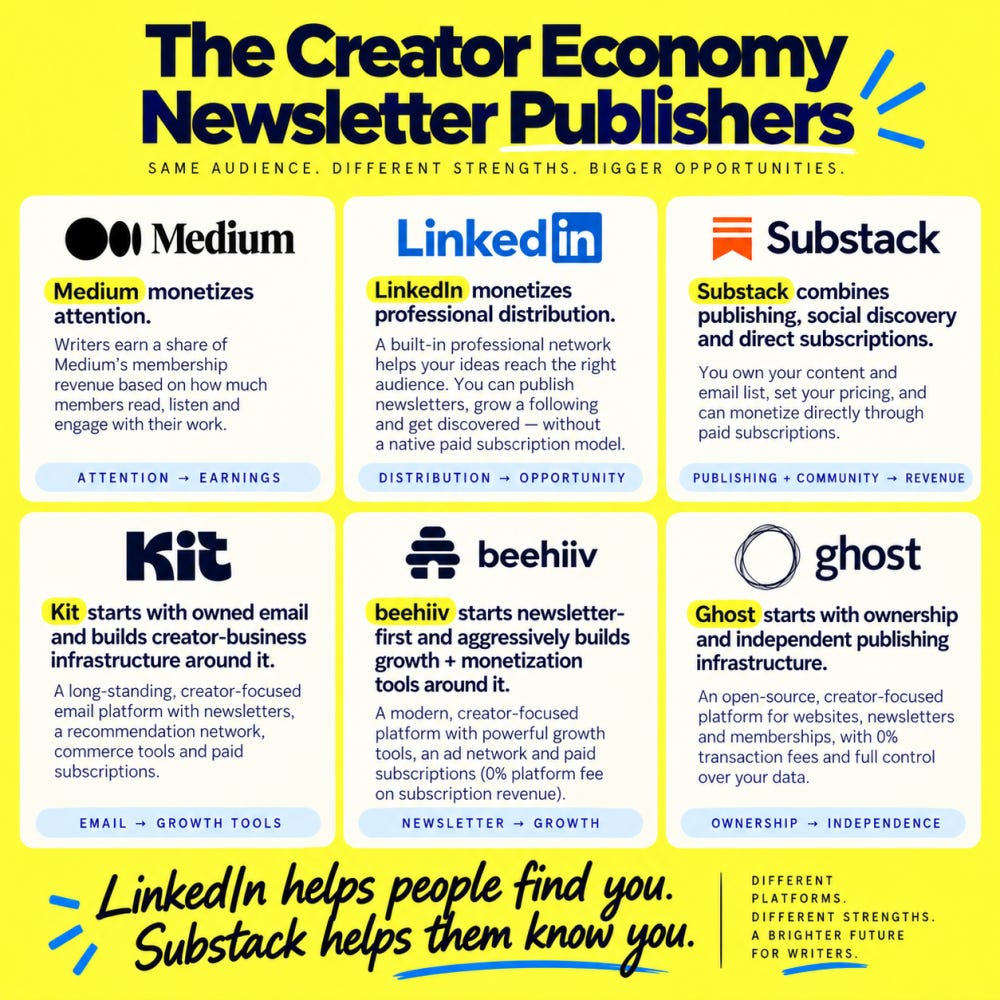
And once I started looking at newsletters that way, I realized Substack and LinkedIn are only part of a much bigger story. Medium, Kit, beehiiv, Ghost and others have all built different versions of the same basic opportunity: helping people publish, build an audience and potentially make money from it.
So before getting into the actual economics, it’s worth looking at what each of these platforms is really built to do.
Different newsletter platforms for different problems
Before Substack, there was Medium.
Medium launched in 2012 and introduced its Partner Program in 2017, the same year Substack was founded. But the two went in very different directions.
Medium pays writers from its overall membership model based on how paying members interact with their work. Substack made the relationship much more direct: readers subscribe to an individual publication, the creator sets the price, and the subscriber list can be exported.
Since then, the category has gotten a lot more crowded.
LinkedIn layered newsletters onto an enormous professional network.
Kit grew from email marketing into a much broader creator-business platform.
beehiiv has leaned heavily into newsletter growth and monetization.
Ghost has focused more on independent publishing, ownership and control.
They all involve newsletters, but they’re not really built for the same job.
And that matters, because choosing where to publish depends a lot less on which platform is “best” and a lot more on what you actually want your newsletter to do.
I don’t think most people need to choose one platform and swear allegiance to it. If professional discovery matters, LinkedIn is hard to ignore. If you want a deeper publishing relationship and direct subscriber emails, Substack becomes much more interesting. And if you’re running a business, an email platform such as Kit can sit underneath both.
The right question isn’t “Which platform wins?” It’s “What job do I need each platform to do?”
What Substack gets very right.
Before I get into the economics, I want to give Substack a lot of credit.
The platform itself is extremely well designed.
I’m fairly technical, so your mileage may vary, but I found the backend easy to figure out. I could realistically start from nothing and have a personalized publication up and running in about an hour, with branding, navigation, email delivery, subscriber management and payments already built in.
The reporting is also much more substantial than I expected. You can track subscribers, paid subscribers, revenue and individual post performance, and connect Google Analytics if you want deeper traffic and conversion data.
And the barrier to entry is remarkably low. Substack is free to start and run; it makes its money when you turn on paid subscriptions and takes 10% of that revenue.
But the biggest positive surprise for me wasn’t the technology.
It was how social the place is.
Publishing and distribution live together. There are long-form posts, Notes, comments, restacks, recommendations, messaging and collaborations, so you’re not necessarily publishing an article and then leaving the platform to figure out how anybody will find it.
That isn’t just my impression. Substack says more than 30% of paid subscriptions now originate within its network, and more than one million posts are discovered by potential subscribers in the app every day.
In my first month, I’ve also had more than 50 one-on-one conversations with people I probably wouldn’t have met otherwise. People have been remarkably accessible.
And then there’s the feature I probably value most:
I can export my subscriber email list.

That may sound boring compared with Notes and paid subscriptions, but from a business perspective it’s huge. Substack lets publishers download their subscriber data as a CSV, including email addresses, That gives you a much more portable subscriber relationship than you get from most social-platform followers..
I’ve spent years building audiences where an algorithm still determines whether I can reach the people who chose to follow me. An exportable email list gives me something much more portable.
So yes, I understand why people love Substack.
I’m very glad I came back.
What I became skeptical about wasn’t the newsletter or even the platform.
It was the economics of making the paid subscription itself the business.
And that’s where I started doing the math.
Same content. Wildly different economics.
This was the part I really wanted to understand when I came back to Substack.
Because the paid newsletter model sounds pretty great.
You write. People pay you to read it. Enough people pay, and suddenly you’ve created recurring revenue around your ideas.
Substack’s default pledge pricing is $8 a month or $80 a year, so rather than cherry-picking an unusually low price, I’m going to use $8 as our baseline. (Substack FAQ)
Start with one $8 monthly subscriber.
Substack takes 10% of every paid transaction. For a standard credit-card payment, Stripe currently charges 2.9% plus 30 cents, plus a 0.5% recurring billing fee. (Substack)
That leaves roughly $6.63 from an $8 subscription, before taxes, refunds, currency conversion or anything else.
So roughly:
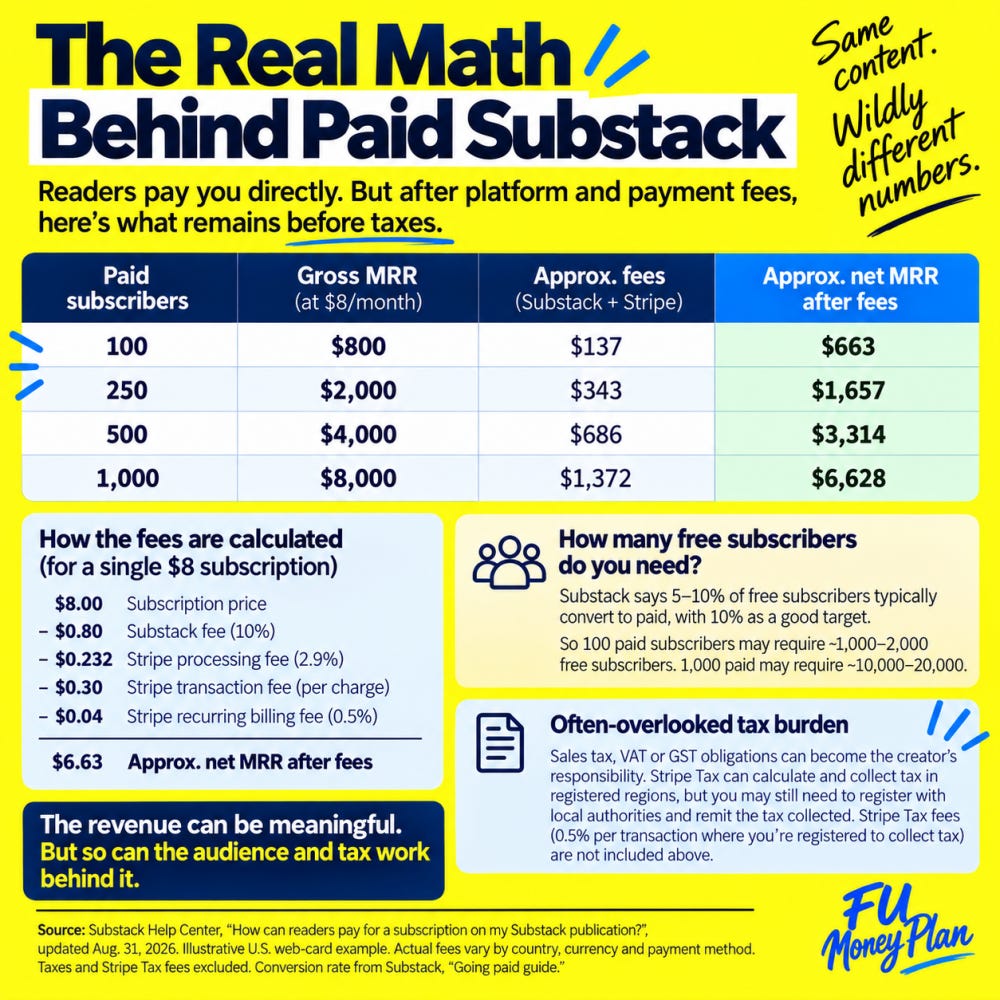
At 1,000 paying subscribers, that’s real money.
But the number I became much more interested in was how many people you need before you ever get to 1,000 paying subscribers.
Substack says it typically sees somewhere around 5–10% of free subscribers convert to paid, with 10% being a good target.
So 100 paid subscribers may mean building an audience of roughly 1,000–2,000 free subscribers first.
500 paid may mean 5,000–10,000.
And 1,000 paid may mean 10,000–20,000.
That’s when I stopped looking at the $8 subscription and started looking at the acquisition.
Because convincing someone to pay $8 is only one part of the job.
First you have to find thousands of people.
And once I started asking successful Substack writers how long that part had actually taken, the economics got a lot more interesting.
The hidden cost of doing business on Substack
The fees surprised me.
The time surprised me much more.
When I asked successful Substack writers how many hours they spent running and growing their publications each week, several had to stop and think about what I meant.
Did I mean the writing?
What about Notes, comments, DMs, restacks, communities, calls and collaborations?
A lot of that apparently didn’t count.
Several essentially told me, “I don’t count that. That’s leisure time.”
I found that fascinating because I would count it.
Writing the newsletter itself is only one part of running a publication. There’s the research, drafting and editing, but also the work involved in getting discovered, talking to readers, collaborating with other writers and keeping people interested once they subscribe.
So I started asking another question:
How long did it actually take you to build the audience?
Among the writers I spoke with, the answer was consistently measured in years.
Some had built their audiences largely on Substack.
Others had arrived with years of work behind them already: blogs, Medium, Twitter, ghostwriting, professional writing, existing email lists or audiences built somewhere else.
Which means a Substack publication may be two years old while the audience, reputation and writing experience behind it are much older.
I started noticing the same thing in the growth articles I saw.
One of the most common customer-acquisition posts here is some version of:
“How I grew my Substack to X subscribers in X months.”
Usually with a very impressive screenshot.
I understand why. If you sell growth advice, demonstrating growth is excellent marketing.
But in every example I personally checked, there was a story before Substack.
Maybe the publication really did reach 10,000 subscribers in 18 months. But the writer may also have entered those 18 months with years of writing experience, an existing email list, a network, an audience or all four.
The number can be accurate while still leaving a brand-new creator with the wrong impression about what starting from zero actually looks like.
So what does that do to the math?
Take 100 paid subscribers at $8 a month.
After the basic Substack and Stripe fees we calculated earlier, that produces roughly $7,954 a year before taxes and other expenses.
Now suppose running and growing the publication takes 20 hours a week.
If you attribute those hours to the publication, that’s about $7.65 an hour in revenue after the basic platform and payment fees.
At 30 hours a week, it’s about $5.10.
At 40 hours, about $3.82.
And even that calculation leaves out whatever acquisition work happened before those 100 paid subscribers existed.
For perspective, 20 hours a week for three years is 3,120 hours.
Thirty hours is 4,680.
I’m not suggesting every successful Substack writer spends that amount of time, or that every hour someone spent building an audience years ago should now be charged against their Substack income.
But time is still an input, and I was surprised by how rarely it appeared in conversations about revenue.
The economics also improve substantially at scale.
At 500 paid subscribers at the same $8 price, you’re around $39,768 a year after those same basic fees.
At 1,000, around $79,536.
That’s real money.
What became clear to me was that I was evaluating the business differently from many of the people I was talking to.
I was asking: What did this earn relative to the time required to build and run it?
Some of them were asking something closer to: Am I getting paid to spend my time doing something I genuinely enjoy?
Those are not the same calculation.
When the subscription model makes perfect sense
The business math I just laid out doesn’t apply equally to everyone on Substack.
For some people, writing is the business.
They’re full-time writers, journalists, authors, or people who genuinely want to spend most of their working life writing and interacting with readers. Several of the people I spoke with basically told me, “I could do this all day.” They love the writing, the conversations and the community, and they don’t even count much of that time as work.
In that case, calculating every hour the way I did above may not be especially useful.
If subscriptions allow you to make a living doing exactly what you want to spend your days doing, fantastic. The publication is the product.
But for most of us, the newsletter is doing a different job.
If you’re employed, consulting, coaching, running a company, or building something on the side, you probably don’t want your newsletter to become another 20-hour-a-week job. You’re using it to build visibility and credibility, yes, but ultimately those things should lead somewhere.
Maybe that’s a better job, promotion or speaking opportunity.
But for most of the people I work with, and in the way I teach newsletters, the bigger goal is to create a gateway into the rest of your business.
Consulting. Coaching. Cohorts. Digital products. Books. Workshops. Advisory work. Whatever sits behind the newsletter.
The newsletter helps the right people discover you, understand what you know, trust your thinking and eventually move toward something else you offer.
That changes the math considerably.
If a newsletter takes 20 hours a week and generates $500 a month in subscription revenue, a professional writer may be perfectly happy with that because they love spending those 20 hours writing.
But if you’re a consultant, those same hours need to help create business beyond the subscription itself.
One $5,000 consulting engagement generated by an article may be worth roughly the same revenue as 63 people paying $8 a month for a year after the basic fees we calculated earlier.
So for most non-writers, I don’t think the question should be:
How many paid subscribers can I get?
It should be:
What is this newsletter helping me build, sell or become known for?
If writing is the product, subscriptions can make perfect sense.
If your expertise, career or business is the product, the newsletter is usually more valuable as the gateway to everything else.
One cultural difference between Substack and LinkedIn
If you’re coming to Substack from LinkedIn or a traditional B2B environment, selling feels very different here.
On LinkedIn, content routinely leads to consulting, coaching, software, services and other relatively high-value purchases.
On Substack, the native transaction is much smaller. An $8 monthly subscription is normal. Free is even more normal.
I’ve met people who proudly told me they’d been reading newsletters for years without ever paying for one. One woman said she read the same publication for several years before finally deciding to “take the plunge” and upgrade. Now that she’d paid for the year, she considered herself pretty much set.
That took some getting used to. 😂
I also got an interesting data point from one of the publications I paid for myself. The publisher had around 120 paid subscribers, roughly 80 of them annual. He told me I was only about the fifth annual subscriber who had purchased without interacting with him first. For most of the others, he estimated it took three to six months of engagement before they upgraded.
That’s one publication, not a study. But it lined up with what I was seeing elsewhere: people here can be very cautious buyers, even at fairly low price points.
Substack’s own rules reinforce the culture. Its Content Guidelines say the platform is intended for editorial content rather than conventional email marketing, and publications can’t exist primarily to advertise outside products or push promotions.
So if you come over from LinkedIn expecting to immediately turn readers into $300 calls, $1,500 cohorts or $5,000 consulting clients, I’d be careful.
One writer I spoke with gave me a better way to think about it. I’d said maybe the goal isn’t always to “grow your Substack.” Maybe it’s to decide what job Substack is supposed to do inside whatever you’re building.
His answer was basically: exactly.
That’s where I’ve landed too.
For me, Substack is strongest at discovery, relationships and depth. I want the right people to find my thinking, spend more time with it and know there’s a larger business behind the newsletter if they ever want to go further.
What happened when I tried it myself?
After all that analysis, I also wanted to see what happened when I actually tried to build on Substack myself.
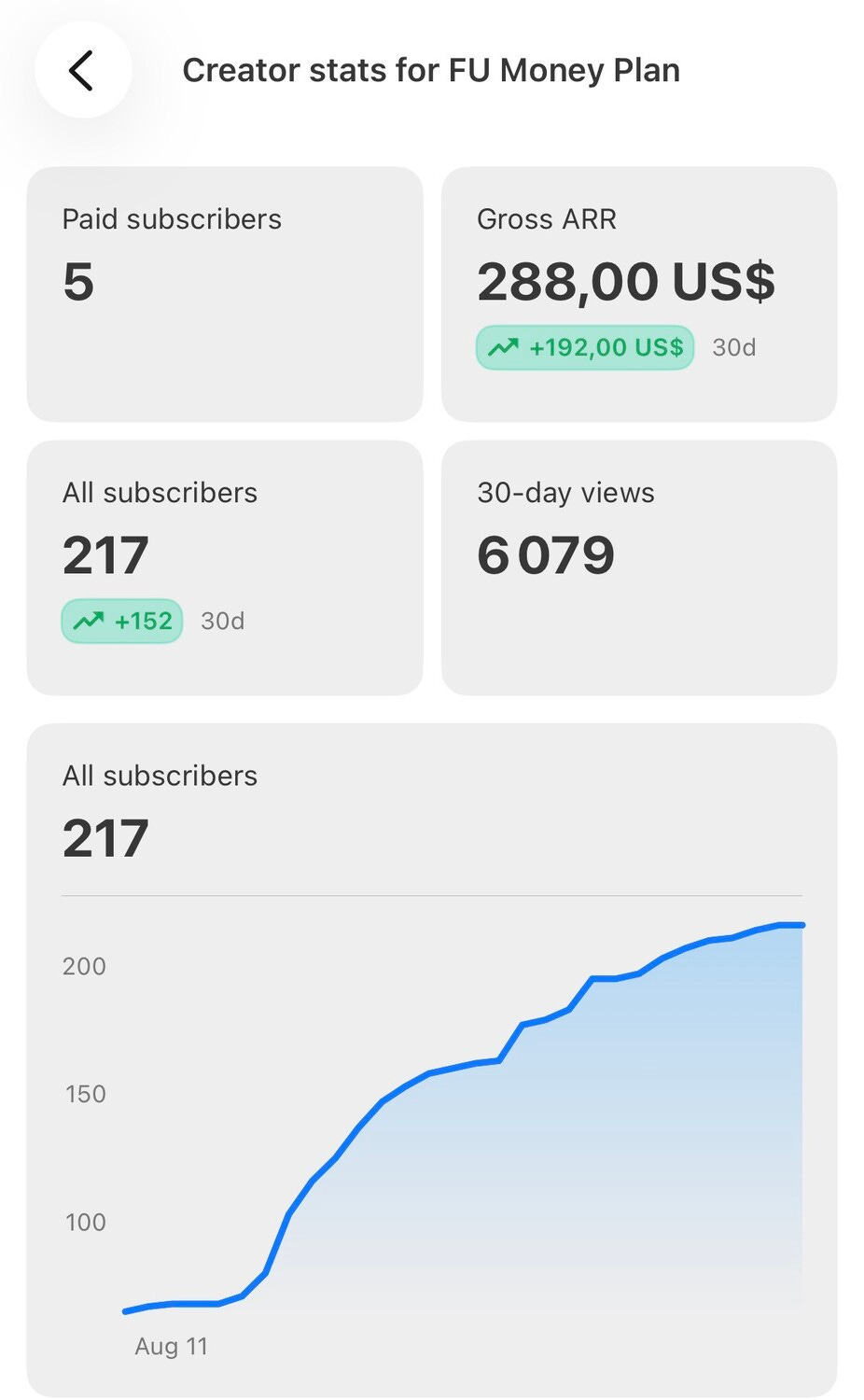
When I came back in August, I had 48 subscribers on the platform. I wasn’t starting from zero visibility, obviously. I already had a large LinkedIn audience and years of publishing behind me, which is exactly the kind of context I wish more growth stories disclosed.
Within my first month, I was at more than 200 subscribers, had generated more than 6,000 views, picked up five paid subscribers, and had more than 50 one-on-one conversations.
I was genuinely happy with that.
The five paid subscriptions were nice, but they weren’t the most valuable result.
The conversations were.
Substack introduced me to people I probably would never have met on LinkedIn. Notes helped me get discovered. The longer articles gave people a much better sense of how I think. And because messaging is so easy, a reader could turn into an actual conversation very quickly.
That is already useful to my business.
So after a month, I’m not looking at Substack and thinking, How do I turn five paid subscribers into 500 as fast as possible?
I’m thinking, How do I keep using this to meet the right people, build a body of work, deepen relationships and create opportunities around the business I already have?
If the paid subscriptions grow too, great.
But they’re a bonus.
The bigger win for me is that I now have another place to build an audience and a direct relationship around my ideas without giving up LinkedIn.
That is much closer to what I was actually looking for in the first place.
I still think everyone needs a newsletter
After all the math, conversations and digging around, I’m actually more convinced about newsletters than I was when I started this experiment.
Just not necessarily about paid newsletters.
Those are two different things.
If writing is your business, paid subscriptions may be exactly the model you want.
But for most professionals, I think the bigger value is everything around the subscription: visibility, credibility, intellectual property, searchability, relationships and a direct audience you can keep building over time.
A newsletter gives you somewhere to develop what you know in public. It gives potential employers, clients, partners and customers enough material to understand how you think. And unlike another short social post, the work can keep getting discovered years later.
That’s why I’m not leaving LinkedIn for Substack.
I’m using them differently.
LinkedIn helps people find me. Substack helps them know me.
And I still want my email list and business infrastructure underneath both, because I have zero interest in spending another eight years building something entirely at the mercy of one platform.
So if you’re happily employed, consulting, building something on the side, running a company or figuring out what comes next, my argument is the same:
You don’t need to become a professional writer.
You don’t need 10,000 subscribers.
You definitely don’t need to spend 30 hours a week hanging out on Substack.
But I do think you should be building a body of work around what you know.
A newsletter is still one of the smartest ways I know to do that.
And if enough people are interested, I’m considering doing a live masterclass showing exactly how I’d set one up: which platform to choose, what to write about, how to structure it, and how to use it to build visibility and eventually lead people toward whatever you actually want to sell or become known for.
Because the hardest part probably isn’t starting a newsletter anymore.
It’s deciding what job you want it to do for you.
And underneath both, I’m continuing to build assets and income streams that give me more control over what happens next.
Which, really, is the whole idea behind the new brand I’ve been building, FU Money Plan.
You don’t wait until you lose the client, the job disappears or the algorithm stops working to start building options. You build them while things are still going well.
If this has you thinking less about “which platform should I use?” and more about what you actually want your work, visibility and income to lead to, that’s exactly what we’re working through in my next FU Money Plan cohort, starting September 22.
We’ll spend four live weeks figuring out what you’re building toward, which income and opportunity paths make sense for you, and what deserves your time next.
And if newsletters are the part you want to learn more about, follow me on Substack and here on LinkedIn. I have a feeling I’m going to have a lot more to say about this experiment.
If you’re already running a business and want help becoming better known for what you do, you can also find my advisory work at UnignorableBrands.co.
If you’re figuring out how to turn what you know into more income, recognition, and career options, subscribe to FU Money Plan
Love me some good content that's evergreen and keeps producing results for years! (Big reason of why I love podcasts and recorded trainings inside other people's communities.) And your point about how a newsletter accumulates IP is a point that nobody considers, but is a HUGE point and so important for your business.
You already know how many of our opinions on how we get to use our content and prioritise connections align, and you just summed it up so well in this entire article.
Stopstack has its own magic, but at the same time, managing paid subscriptions and the constant worry about churn (and making sure that people stay in this kind of subscription-style model) is actually taking up a lot of our bandwidth and time.
We could otherwise spend it somewhere else, whether in our business or outside of it. I wish more people talked about using Substack more as a launchpad, as an entry point, a shop entrance door, rather than where people are necessarily wanting to host their entire product suite.
Precision about who we’re speaking to in our content trumps audience size and all the engagement people seem to be so obsessed about.