


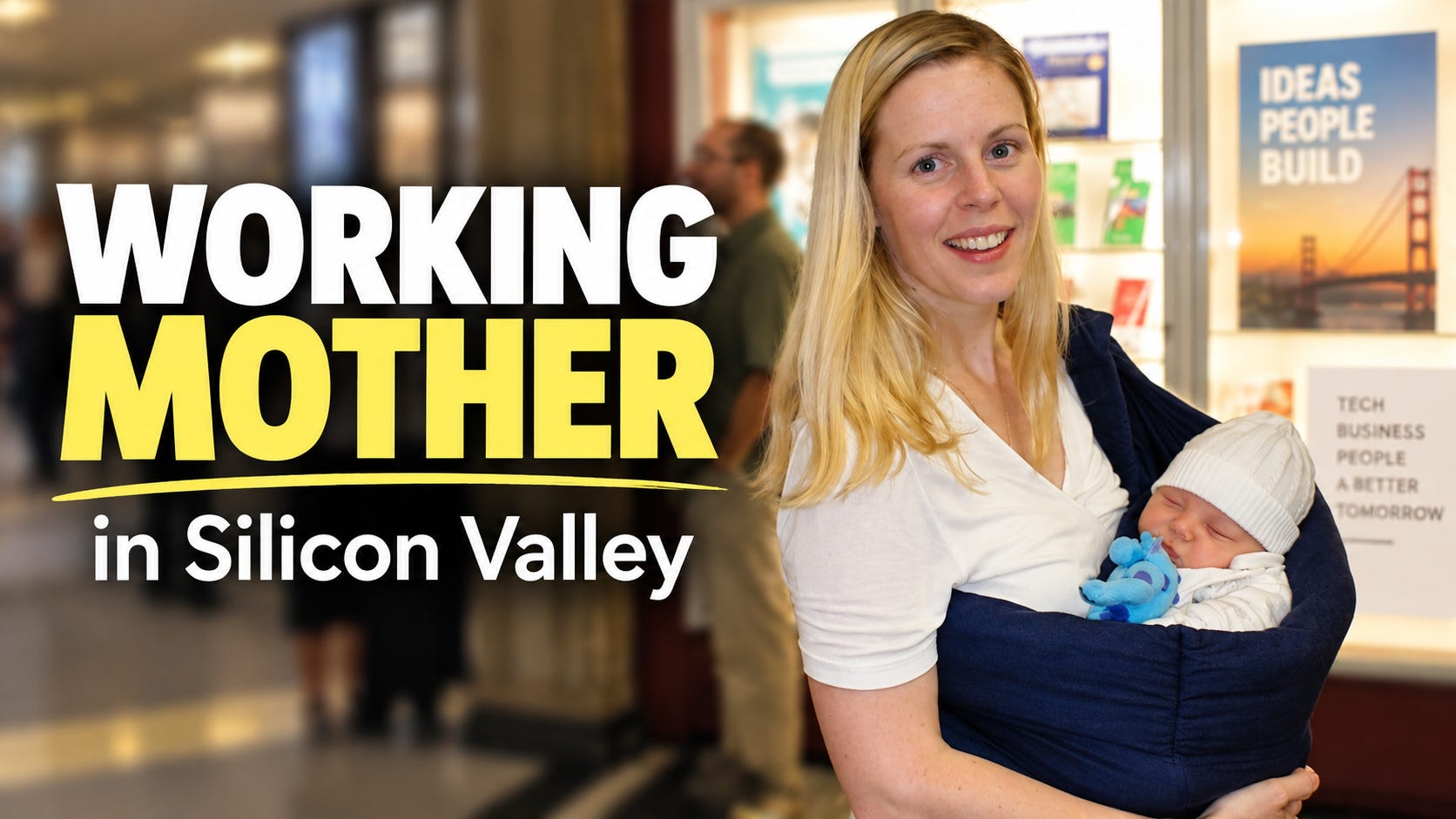
I spent 18 years working in B2B tech in Silicon Valley, from 2000 to 2018.
I loved the work. I was ambitious, competitive and wanted to move up. But becoming a mother changed the way I was treated at work in ways I hadn’t fully expected.
The strange thing was that having children seemed to work in opposite directions for men and women. A man became a father and could look more stable, responsible and established. A woman became a mother and suddenly people started wondering whether she was still serious about her career.
I saw that difference up close.
Despite being married, I was afraid to tell my boss I was pregnant because I didn’t want it to negatively impact my career. So I didn’t say anything until I was five months along.
When I finally told my boss
The company had more than 7,000 employees at the time, and I found out there wasn’t even an official maternity leave policy in place.
When I asked HR why not, they said:
“Well, we haven’t really needed one yet.”
That was 2002.
When I finally told my boss I was pregnant, she gave me a tight-lipped smile and said:
“I thought you wanted me to help fast-track you for management, but looks like your plans have changed. Congratulations.”
The irony was that, at more than seven months pregnant, I pulled an all-nighter at work because a new software build had run into serious technical problems.
I eventually went home, slept for a couple of hours, and came straight back.
Whatever anyone thought about my pregnancy, I definitely wasn’t slacking on the job.
The thing is, I actually liked my boss.
She was a nice person and, for the most part, a good manager. I don’t think she was trying to make my life difficult. Looking back, I think she simply had no idea how to handle a situation like this.
And honestly, I’m not sure the company gave her much help.
This was a company with more than 7,000 employees that didn’t even have an official maternity leave policy. So what kind of training were managers getting on pregnancy, maternity leave, breastfeeding, sick children, or helping someone return to work after having a baby?
Probably not much.
That’s what makes this bigger than one manager. She was trying to manage a situation the company itself didn’t seem prepared for.
Returning to work
After my short, unpaid California maternity leave, I came back to work determined to prove that nothing had changed.
Almost immediately, I was told not to expect any “special favors.”
If my child was sick, I needed to take the entire day off. Working from home next to a sick child was considered “vacation time.”
I was also breastfeeding, which meant I needed to pump during the workday.
I was told I could use a utility closet.
My boss would regularly circle around my cubicle while I was gone. I can only assume she was making sure I hadn’t decided to disappear in there for a luxurious nap.
So I rushed.
Pump. Clean everything up. Get back to my desk.
A lot of days I barely ate lunch because pumping had essentially become my break.
I remember one day heading toward the elevator when my boss stopped me and asked why I was going home so early.
I said, “I’m not going home. I just need to get outside for ten minutes. I haven’t had fresh air or a real lunch break in months.”
There were physical realities too
Coming back to work also meant dealing with things that had nothing to do with how ambitious or committed I was.
I was exhausted because I had been up with the baby all night.
I kept extra clothes at work because sometimes I leaked through my shirt.
Pregnancy and breastfeeding had changed my body dramatically, and I dealt with men staring at my chest even though I was wearing completely normal clothes.
Sometimes simply thinking about my baby could trigger my milk to let down.
A father could sit at his desk and miss his child.
My body could physically remind me that mine needed me.
And then I still had to clean myself up, walk into the next meeting and perform my job exactly as expected.
That’s the part I think a lot of workplace conversations missed. Having a baby didn’t just add something to my calendar. My body had gone through a massive physical change, I was caring for a newborn at night, and then I was expected to walk back into work as though none of that existed.
The same family looked different on a man
My boss’s boss was a friendly man who took an interest in mentoring me.
When he saw me after maternity leave, he joked:
“I’m so glad you came back.”
I think he meant it warmly. He liked working with me and wanted me there.
But just imagine: would he ever have said that to a man who had just had a baby?
His office was filled with photos of his five children and his stay-at-home wife.
He could have five children and keep climbing.
I had one child, and suddenly it felt like management was questioning whether I even wanted a career anymore.
That contrast stayed with me because you saw versions of it everywhere.
Men talked openly about their children. They kept framed photos on their desks. Becoming a father could make a man look more stable, more responsible, even more established. He had a family to support.
Motherhood often triggered a completely different set of assumptions.
Will she need more flexibility?
Will she be distracted?
Will she turn down the promotion?
Will she eventually leave?
And those assumptions affect careers. They influence who gets mentored, who gets trusted, who gets stretched, who gets promoted, and who gets watched more closely.
That was the real double standard. The same life event could strengthen a man’s professional image and weaken a woman’s.
There was a networking cost too
Being a woman also changed how I built relationships at work.
If a male executive wanted to mentor me, or I was working closely with a male client, I had to think about things men working with other men probably never had to consider.
Are we going to end up alone somewhere late at night?
Is the office door closed?
Is this dinner getting too late?
Is he interpreting this relationship differently than I am?
At conferences, it could get even more awkward.
I was hit on. I was propositioned. I was invited into situations that had absolutely nothing to do with business.
Meanwhile, the men could go out drinking together, keep talking shop, and build relationships.
Sometimes I went back to my hotel room instead.
And that has a career cost.
From 9 to 5 to 24/7
The other thing nobody really acknowledged was that my life had essentially doubled.
At work, I was still expected to show up as the same employee I had been nine months earlier. Same energy. Same output. Same availability.
But my day looked nothing like it had before.
I was usually up between 5:00 and 5:30 in the morning to feed the baby. If he went back to sleep, I’d use that little window to exercise in the living room, do my Kegels and try to rebuild a body that had just gone through pregnancy and childbirth.
Then shower. Get dressed for work. Pack my breast pump, bottles and cooling bags. Pack the diaper bag. Make sure the baby had everything he needed for daycare. Get my own food together.
All of that happened before about 7:30 in the morning.
I had used public transportation before having a baby, but suddenly I needed a car because now I was commuting with a baby, a car seat, daycare supplies and pumping equipment.
Funny story: a single male colleague ended up carpooling with me and the baby. We used to laugh about the baby seat permanently installed in his car and what his friends must think. He got half the gas money, I got help with the commute, and we actually had a lot of fun driving together.
Then I’d drop the baby at daycare and go do a full workday.
At the end of that workday, the second one started.
Pick up the baby. Drive home. Take him for a walk. Dinner. Bath. Story. Bedtime.
Then I’d often open the company laptop again and finish whatever I hadn’t managed to get done during the day.
And, yes, I still had a husband in all of this. If we were lucky, there was a little bit of time left for each other before bed.
Then repeat.
There was food to prepare too. Breastfeeding made me ravenously hungry, while at the same time I felt enormous pressure to lose the baby weight. So I was batch cooking, packing lunches and making salads late at night, constantly caught between wanting to eat everything in sight and wanting my old body back.
And the next morning, 5:00 or 5:30, it started again.
What I find strange looking back is how little acknowledgment there was that anything had changed.
At work, you were just supposed to carry on. Be the same person. Keep up. Don’t ask for too much flexibility. Don’t look tired. Don’t let motherhood interfere.
Except you weren’t the same person.
You were somebody’s mother now.
Your body had changed. Your sleep had changed. Your mornings had changed. Your evenings had disappeared. Your relationship had changed. There was another human being whose survival literally depended on you.
And there wasn’t much space to talk about any of it.
The other working mothers were mostly doing exactly what I was doing: trying to get through the day.
And I often found it difficult to relate to stay-at-home mothers because our days looked so completely different.
Maybe the stay-at-home moms had more opportunity to support one another.
The working moms were just too damn tired.
Mostly, we shuffled along and figured it out ourselves.
The women who stay play by the rules
I watched talented women make very different choices once marriage and children entered the picture.
Some got married and left the workforce as soon as they could. Others stayed, but many became incredibly tough.
Some of the hardest managers I ever worked for were women. At the time, I often experienced that as coldness.
Now I think it was something different.
It was survival.
Because the women who stay learn very quickly what the workplace rewards.
Don’t show too much emotion. Don’t ask for too much flexibility. Don’t look overwhelmed. Don’t let family interfere. And never give anyone a reason to question whether you’re committed.
Femininity can be useful strategically. Charm helps. Looking attractive can help. A little warmth can go a long way politically.
In the workplaces I knew, the traits rewarded at the top were still largely the ones traditionally coded as masculine: toughness, control, detachment, decisiveness, the ability to make difficult calls without appearing affected by them.
Look feminine.
Act like one of the boys.
That’s the game.
And if that’s how you learned to survive and move up, of course you’re more likely to expect the women coming behind you to play by the same rules.
We were all women, but we weren’t necessarily having the same experience.
I don’t remember much sisterly solidarity in those environments. Everyone was dealing with her own version of the problem.
Working mothers were exhausted. Women without children were busy proving themselves. Women who had already made it into management had often done so by adapting to a workplace that wasn’t particularly interested in making room for caregiving.
So women make different choices.
Some leave. Some reduce their hours. Some change careers. Some decide they’d rather work for themselves.
And the women who stay?
They learn the rules. And they play by them.
Eventually, I left too
By the time I was pregnant with my second child, I sat down and did the math.
And the math just didn’t math.
Daycare for two kids. The commute. My salary. The constant logistics required just to get everyone where they needed to be every day.
And I knew it was only going to get more complicated. School schedules. Activities. Doctor appointments. Sick days. Holidays. Pickups. Somebody had to manage all of that.
Then I looked at what moving up in my career would require.
More responsibility meant more hours. More hours meant less time with my kids.
And I remember thinking: then why the hell did I have them?
But I didn’t want to stop working.
I didn’t become a stay-at-home mom.
I left corporate. I didn’t leave my career.
I joined a B2B agency working with tech companies in Silicon Valley. I was still doing serious work, still earning money and still building my career. I was just looking for a way to do it that gave me more control over my life.
That eventually led me further into entrepreneurship.
I could work from home when I needed to. I could research, make sales calls, do cold outreach and build something from my computer. I could arrange childcare when I needed to pitch a client or attend a networking event instead of handing over most of my week by default.
Eventually I had an office and employees, but I still controlled my time. I could pick up my kids, go to school events, volunteer in the middle of the day, and rearrange things when one of them needed me.
It wasn’t perfect. Running a business while raising children came with an entirely different set of headaches.
But it worked.
And more importantly, it gave me control.
I didn’t call it an FU Money Plan then
I didn’t have a name for any of this at the time.
I just knew I needed more control.
I still wanted to earn money. I still wanted a career. I still wanted to be ambitious. But I didn’t want one employer or one rigid way of working to decide how much of my children’s lives I was allowed to be part of.
Looking back, that was probably my first FU Money decision.
FU Money, at least the way I think about it now, isn’t about becoming rich enough to never work again. It’s about having enough income, skills and options that you can look at a situation that no longer works for you and say, I need another way.
That’s what I did.
I left corporate, but I didn’t leave my career. I kept working in B2B tech, eventually built my own company, and created a way of working that gave me considerably more control over my time.
Thank God it worked.
I also know entrepreneurship isn’t an answer for everyone. Women shouldn’t have to start businesses just to make motherhood and meaningful work coexist.
But that experience is a big part of why I care about FU Money today.
I know what it feels like when the math stops working and you realize you need more options.
This is part of why women leave
I’m not telling this story because I’m bitter. I had a good career, worked with some wonderful people and had opportunities I’m genuinely grateful for.
I’m telling it because I think we still underestimate what happens when women eventually sit down and calculate whether the whole setup makes sense.
That’s what I did when I was pregnant with my second child.
Two kids in daycare. The commute. My salary. The logistics. And if I wanted to keep climbing, I would need to work even more hours and spend even less time with my children.
At some point, the math just stopped working.
I didn’t stop caring about my career. I left corporate and kept working in B2B tech. Eventually, I built my own company and created a way of working that gave me more control over my time.
Looking back, that was probably the beginning of what I now call FU Money Plan.
I didn’t need enough money to never work again. I needed skills, income and options so that when one way of working stopped making sense, I could choose another.
A lot of women eventually make some version of that calculation. Money matters, but so do childcare, time, flexibility, career upside and how much of your children’s lives you’re willing to miss to keep moving up.
So before we ask why women leave, I think we should ask a better question:
What made staying stop making sense?
Maybe the least we can do is stop treating motherhood as evidence that a woman is less serious about her career.
Even non-corporate positions treat motherhood as if it were a non-entity. I left a full-time therapy position in a school district to start a private practice after the teachers' union rallied the school board to deny me a part-time position because I was tenured and they didn't want to see tenured people go part-time, even though that's what I wanted/needed! The group that expected me to pay dues to belong sabotaged my needs when I became a mother!
I've met so many talented women at the school gates, women who have left careers for the reasons you've written here. You just about make it work with one child but with 2 or more the math doesn't add up and the impact it has on your health, your marriage and the relationship you have with your kids are all signifcant because they all require some kind of sacrifice. You'd think women would naturally come together, kids or not, but in reality that very very rarely happens, everyone is trying to protect the tiny piece of sanity and ambition they have left.