



The internet is full of books, courses, templates, apps, and now AI tools promising to help you “10x your productivity” and get more done. You can build an elaborate Notion dashboard, color-code your calendar, automate your task list, and have AI plan your entire week. None of it helps very much if you are getting extremely efficient at doing work that should not be taking up your time in the first place.
You can be incredibly organized and still get very little return on your time. You can finish twenty things in a day and have almost nothing meaningful to show for it. You can even become more productive and accidentally create more capacity for work you never needed to be doing.
That is why I think most time-management advice starts in the wrong place. The first question should not be, How do I get more done? It should be: Who owns your time?
What Are All Those Hours Building?
Because the problem usually isn’t that you can’t fit enough into the day. It’s that work has quietly expanded to take more of your life than you realize.
If you work eight hours a day, work already takes roughly half of your waking hours. And that’s assuming it actually stops at eight. It doesn’t include checking email after dinner, thinking about a client while you’re making coffee, commuting, preparing for tomorrow, Slack, DMs, admin, or the twenty-minute task that somehow ate ninety.

All of that counts.
So before you try to squeeze more productivity out of those hours, I think there is a much more useful question:
What are all of those hours actually building?
If your job disappeared tomorrow, what would still belong to you? If your biggest client walked away, what would remain? If you stopped working for a month, would everything stop earning too?
That’s where time management becomes an FU Money problem.
So I Wrote a Book About It
If this were an easy problem to solve, and I’d already found a system that solved it, I probably wouldn’t have written an entire book about it, would I?
I’ve read the big productivity and time-management books. I’ve tried the systems, the tools, the apps, the templates. And I still hadn’t found anything that really addressed the problem I kept running into: how do you decide what is actually worth doing when nobody else is structuring your time for you?
Nine years as a solopreneur — especially one with ADHD — and a mother of four forced me to completely rethink how I work.
When you have a 9-to-5, a lot of the structure is built for you. Someone decides when you work, where you work, what your priorities are, which meetings you attend, what deadlines you have, and usually what success looks like.
Once you work for yourself, all of that disappears.
Now you have to decide what to work on, when to work on it, what not to work on, how much time something deserves, when something is finished, and whether any of it is actually moving the business forward.
Add to that a family, a life outside of work, house to take care of, meals to cook, homework to help the kids with, and a spouse to spend quality time with, and time gets stretched real thin real fast.
After managing a team and consulting for a large part of the past nine years, I’ve seen the same problem over and over again. Time management is an issue. No one is sitting around wondering what they should do. They usually know.
Actually getting the right things done is the hard part.
So I wrote the book I couldn’t find.
Not a short one, either. 125 pages.
The Time Is Money System is my attempt to rethink productivity and time management for people who have to create the structure themselves — entrepreneurs, consultants, freelancers, and anyone building something outside a traditional job.
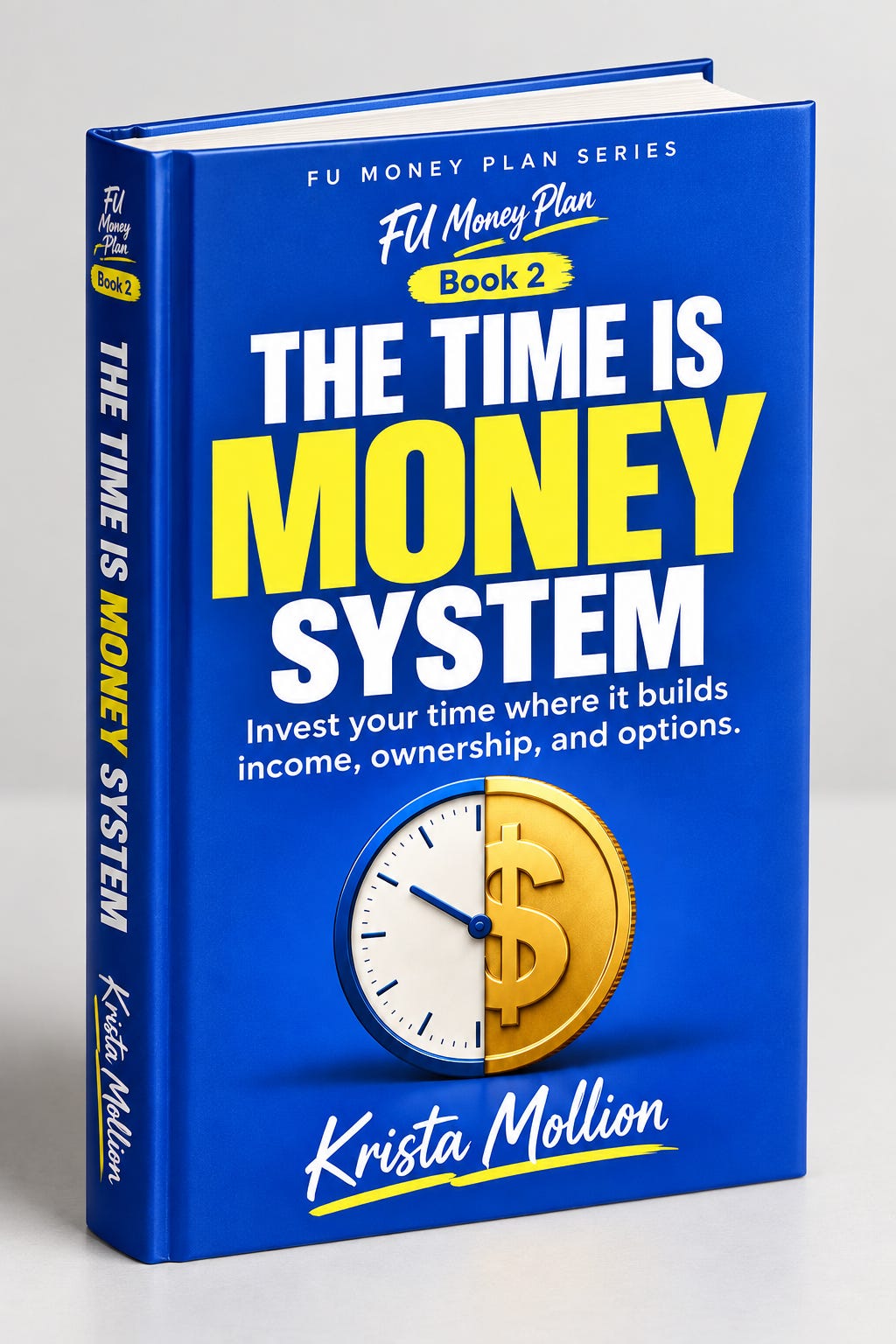
The Time Is Money System — Book 2 in the FU Money Plan series
What’s Actually Inside the Book?
This is not a book about waking up at 5 a.m., taking a sauna and a cold plunge, drinking wheatgrass juice, and meditating before the rest of the world wakes up. If that’s your thing, fantastic.
This book is about what happens after you sit down to work.
It’s about figuring out what your time is actually worth — and then using it accordingly.
I start with the idea that time is capital. You only get so much of it, so the question isn’t simply whether you were productive today. It’s whether the hours you spent are building anything that makes your future easier, more profitable, or less dependent on your continued labor.
From there, I get very practical.
Inside the book, I walk through:
the five jobs your work can have: Earn, Sell, Build, Operate, and Learn
how to tell whether your work is actually compounding into income, assets, reputation, relationships, or future opportunities
why making good money can still leave you completely dependent on your time
how perfectionism, DIY syndrome, constant restarting, endless learning, and disguised busywork quietly eat enormous amounts of your life
how to look at your work mix and decide whether your time is going where you actually want it to go
why time, energy, and focus have to be managed together
how to protect the parts of your life that work is not allowed to consume
how to find your time leaks and decide what deserves space on your calendar
when to delegate, automate, eliminate, or simply pay someone else
how to start building revenue that can grow without requiring an equal increase in your hours
And at the end, you build your own FU Time Plan around the life, work, and income you’re actually trying to create.
Because the goal isn’t to become better at cramming more work into every available hour.
It’s to get much more deliberate about what gets your hours in the first place.
If You Want To Stop Feeling Behind or Stretched Thin, Get the Book
You do not need another productivity app.
You probably don’t need another prettier calendar, either.
You need to get much clearer about what deserves your time, what doesn’t, and what all those hours are actually building.
That’s what The Time Is Money System is for.
Paid FU Money Plan subscribers get $10 off.
Want to See the System First?
I originally created a 20-minute version of this training as a bonus for the founding FU Money Plan cohort.
It walks through some of the core ideas from the book, including the five jobs your work can have — Earn, Sell, Build, Operate, and Learn — and how I think about allocating time when nobody else is structuring the workday for you.
Paid subscribers can watch the full training below. 👇
Approx. 20 minutes
